Watch a busy checkout for a minute and you will see where time goes: the cashier tilting a product back and forth, squinting at a crumpled label, typing in a code by hand. A scanner that suits your products clears that bottleneck. One that doesn’t creates it.
Barcode scanners all look similar, but they read different kinds of code in different ways. Here is a plain-language guide to choosing one.
First question: what are you actually scanning?
- 1D (linear) barcodes are the familiar black-and-white stripes printed on almost every packaged product, shelf label and carton.
- 2D codes, such as QR codes, pack far more information into a small square. They appear on newer packaging, loyalty cards, tickets, payment confirmations and, increasingly, on customers’ phone screens.
If you only ever scan product barcodes, a 1D scanner does the job. If you expect QR codes or codes shown on a phone, choose a 2D scanner, which reads both.
Handheld scanners for everyday retail
2D imagers. The VQR100 2D CMOS scanner and the S7700 read all standard 1D and 2D barcodes, whether they are printed on goods and paper or shown on an electronic screen, at up to 300 scans per second. They are the safest all-round choice for a modern shop.
Laser scanners. The US2016PRO handheld laser scanner is built for retail logistics and warehouse management. It gives stable, fast and precise reads, including very small and very long barcodes.
CCD scanners for tired labels. Real-world barcodes get scratched, smudged and half-torn. The V12PRO long-range CCD scanner uses a highly sensitive linear image sensor that can still interpret damaged, incomplete or fuzzy barcodes. It reads at up to 500 scans per second, handles 1D codes on screens, and is plug-and-play.
Hands-free omnidirectional scanners for busy checkouts
At a high-volume till, picking up a scanner for every item slows everything down. A hands-free, omnidirectional scanner sits on the counter, and the cashier simply passes products in front of it in any orientation.
The S7730 omnidirectional multi-line laser scanner was designed specifically to clear the checkout bottleneck. It projects 20 scan lines in 5 directions at up to 1,500 scans per second, and a single key switches it to single-line mode when you need to pick out one barcode from a crowded label.
Wireless scanners for freedom of movement
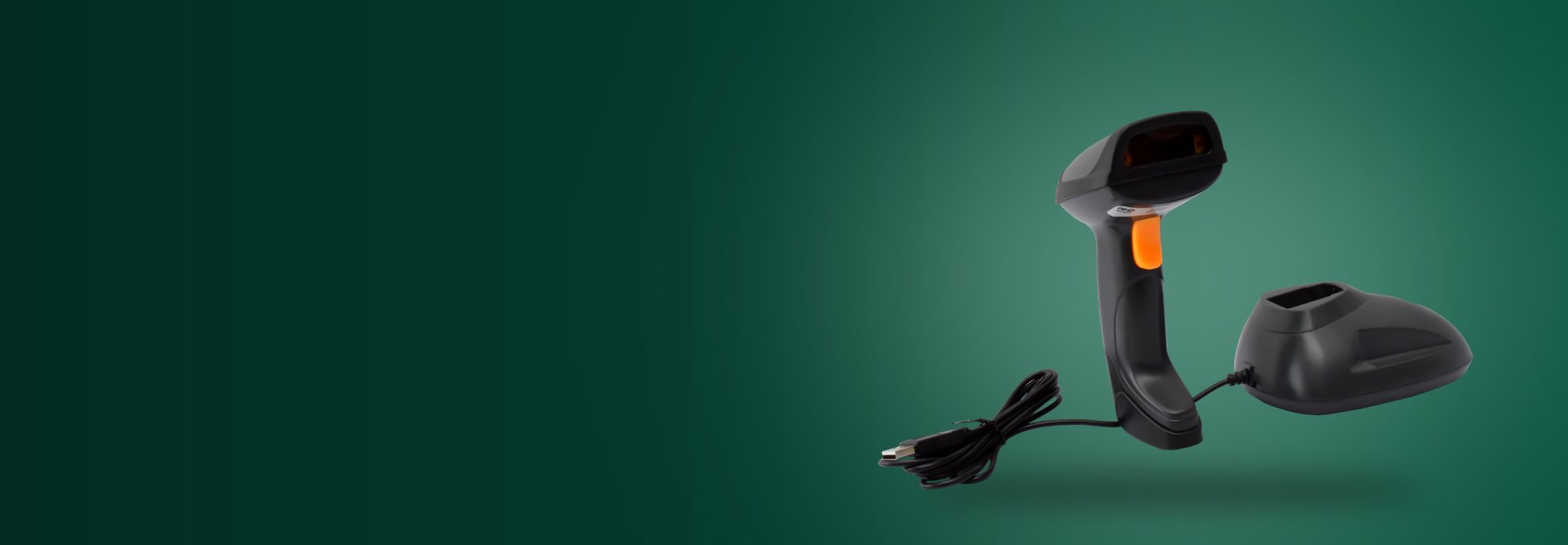
Bulky items such as bags of rice, cartons of drinks or furniture shouldn’t have to be lifted onto the counter. A cordless scanner like the W16 Wireless Scanner, which docks in its own cradle, lets the cashier walk to the item, scan it and return the scanner to its base.
Quick guide
| If your business… | Consider |
|---|---|
| Scans product barcodes and QR codes, including on phones | VQR100 or S7700 |
| Runs a warehouse or logistics operation | US2016PRO |
| Deals with worn, damaged or faded labels | V12PRO |
| Has long queues at a busy checkout | S7730 hands-free |
| Sells large or heavy items | W16 Wireless |
Before you buy: three quick checks
- Connection: USB plug-and-play scanners work with most POS software out of the box. If your software expects a serial (COM) device, the VQR100 and S7700 support a virtual serial port.
- Your busiest moment: size the scanner for peak hour, not for a quiet Tuesday morning.
- Your worst label: bring a sample of your most awkward barcode to our store and test it on the spot.
Browse our full barcode scanner range, or request a quote and we will recommend the right scanner for your counter, with bulk pricing if you are equipping several tills.